

Mastology is the medical speciality concerned with the study, diagnosis, prevention and treatment of all breast conditions, both benign and malignant.
It is an interdisciplinary field that encompasses clinical examination, imaging, interventional diagnostic procedures and surgical management, with the aim of providing comprehensive breast health care.
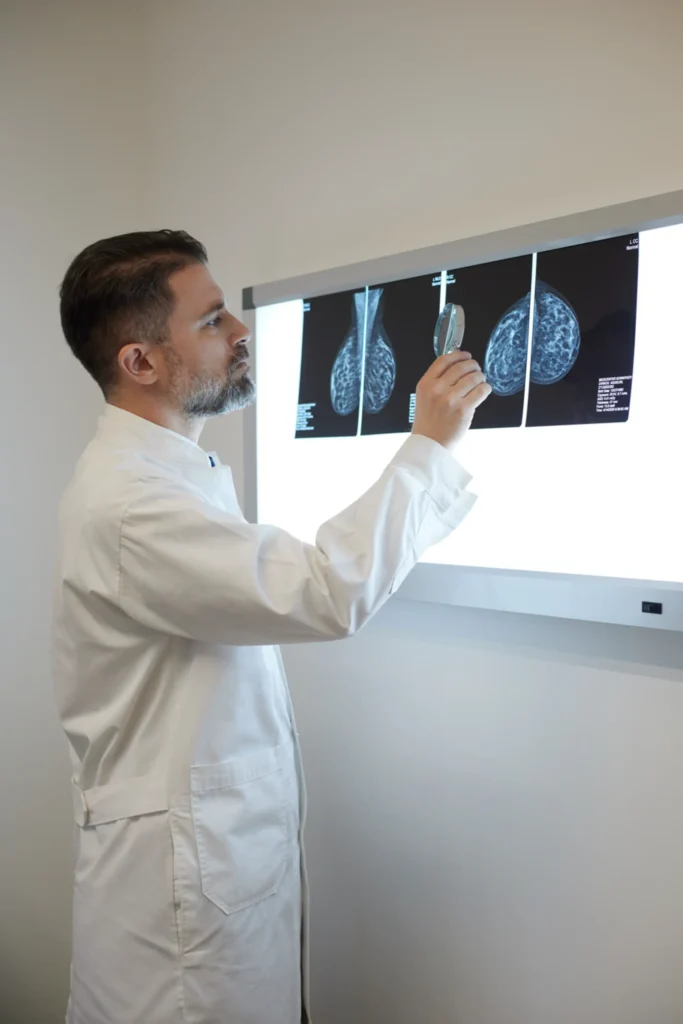
Methods used:
Clinical Breast Examination
Definition
A clinical breast examination is the systematic palpation and assessment of the breasts and axillary lymph nodes by a specialist doctor, with the aim of detecting any potential pathological findings.
Techniques/Methods
- Breast palpation following a predetermined sequence (quadrants, submammary region).
- Palpation of axillary and supraclavicular lymph nodes.
- Visual inspection for symmetry, skin, and nipples.
- Use of ultrasound, where required, for immediate correlation.
Advantages
- Immediate, painless and safe procedure.
- Ability to provide immediate assessment and guidance for further investigation.
- Useful even in young women where imaging methods may be less revealing.
Who is it for
- All women, regardless of age.
- Particularly for women with symptoms (pain, palpable lump, discharge).
- For high-risk women who require regular monitoring.
Objectives
- Early detection of changes or abnormalities.
- Determining the need for further tests.
- To educate the woman on self-examination.
Breast Ultrasound
A non-invasive imaging examination that uses sound waves to visualise the breast.
Techniques/Methods
- High-resolution linear probe.
- Colour Doppler for blood flow.
- Targeted examination of suspicious areas.
- Combination with clinical examination for a comprehensive assessment.
Advantages
- Completely safe, with no radiation.
- Highly effective in dense breasts (young women).
- Ability to distinguish solid from cystic lesions.
- Immediate targeted investigation of a palpable finding.
Who is it for
- Women under 40 years of age.
- Pregnant or breastfeeding women.
- Women with dense breasts.
- All women for supplementary/specialised screening.
Objectives
- Investigation of symptoms.
- Characterisation of lesions.
- Referral for further tests or biopsy.
Mammography
Definition
An imaging method that uses low-dose radiation to detect pathological changes in the breast.Techniques/Methods
- Digital mammography.
- Tomosynthesis (3D mammography).
Advantages
- Gold standard for screening.
- Detection of microcalcifications not visible in other examinations.
- High sensitivity for early diagnosis.
Who is it for
- Women over 40 (annual screening).
- High-risk women from a younger age.
- Women with previous conditions or a history of surgery.
Objectives
- Early detection of cancer at an early stage.
- Assessment of suspected cases or findings from other tests.
Breast Magnetic Resonance Imaging (MRI)
Definition
Breast magnetic resonance imaging is a highly sensitive imaging examination that uses a magnetic field and contrast agent to produce detailed images of the mammary gland.Techniques/Methods
- Dynamic breast MRI with contrast agent.
- Examination using specialised breast coils.
- Comparison of multiple contrast-enhanced phases.
- Combination with mammography/ultrasound for a comprehensive assessment.
Advantages
- The most sensitive examination for detecting breast cancer (particularly in dense breasts).
- It reveals lesions that may not be visible on mammography or ultrasound.
- Ideal for assessing the extent of the disease prior to surgery.
- Excellent for follow-up after treatment or in women with implants.
Who is it for
- High-risk women (BRCA1/2, family history).
- Women with dense breasts where other tests are less informative.
- Patients with a recent diagnosis of breast cancer.
- Women with silicone implants.
Objectives
- Detection of small or hidden tumours.
- Assessment of the extent of cancer prior to treatment.
- Monitoring of residual disease.

Breast biopsy (FNA, core biopsy, vacuum-assisted biopsy) Definition
Techniques/Methods
- FNA (fine needle aspiration, collection of cells for examination) for cystic lesions.
- Core biopsy (coring needle biopsy).
- Stereotactic biopsy for microcalcifications.
- VAB for larger or more difficult sites.
Advantages
- Accurate diagnosis.
- Avoids unnecessary surgery.
- Minimally invasive, under local anaesthesia.
Who is it for
- Patients with suspicious findings on mammography/ultrasound/MRI.
- Women with a palpable lump.
Objectives
- Definitive diagnosis.
- Establishment of a treatment plan.
- Accurate characterisation of the type of cancer.
Breast Surgery
Definition
Surgical management of breast conditions, both benign and malignant, using surgical techniques.Techniques/Methods
- Breast-conserving surgery.
- Mastectomy (total/modified).
- Sentinel lymph node biopsy.
- Breast reconstruction in collaboration with a plastic surgeon.
Advantages
- Personalised treatment.
- Combination with oncoplastic techniques for a better aesthetic result.
- Safety and effectiveness when performed by a specialist breast surgeon.
Who is it for
- Women diagnosed with breast cancer.
- Women with benign lesions requiring removal.
- Women at high risk for preventive surgery.
Objectives
- Safe removal of the tumour.
- Breast conservation where possible.
- Optimal oncological and aesthetic results.
Oncoplastic Breast Surgery
Definition
Oncoplastic surgery combines the principles of oncological surgery with plastic surgery techniques, allowing for the safe removal of the tumour whilst achieving an excellent aesthetic result.
Techniques/Methods
- Extensive tumour resections with breast reconstruction.
- Symmetrical procedures on the other breast (where necessary).
- Use of local flaps for tissue replacement.
- Immediate reconstruction following mastectomy in collaboration with a plastic surgeon.
Advantages
- Greater likelihood of breast conservation.
- Better aesthetic result without compromising oncological safety.
- Increased self-confidence and psychological well-being for the patient.
- Combination with modern oncological treatment protocols.
Who is it for
- Women with breast cancer who are eligible for breast-conserving surgery.
- Women with a tumour size or location that requires careful reconstruction to ensure symmetry.
- Patients who wish to maintain or improve the shape of their breast.
Objectives
- Complete oncological removal of the tumour.
- Optimal aesthetic result.
- Reduction in the need for corrective surgery in the future.
Breast Screening
Definition
Breast screening involves systematic examinations of healthy women with no symptoms, with the aim of early detection of cancer.
Techniques/Methods
- Annual mammography from the age of 40 onwards.
- Personalised combination of mammography and ultrasound for dense breasts.
- Breast MRI for high-risk women.
- Clinical breast examination.
Advantages
- Detection of cancers at an early stage, when they are fully treatable.
- Reduced mortality.
- Less invasive treatments due to early diagnosis.
- Effective detection of microcalcifications.
Who is it for
- Women over 40.
- Women aged 30–40 with risk factors.
- Women at high risk from a younger age (genetic testing, family history).
Objectives
- Comprehensive, early and reliable detection of malignancies.
- Creation of a personalised prevention plan for each woman.
- Protection of breast health in the long term.
High-Risk Follow-up
Definition
Systematic, intensive monitoring of women at increased risk of developing breast cancer.Techniques/Methods
- A combination of mammography, ultrasound and breast MRI.
- Personalised protocols.
- Genetic testing where indicated.
Advantages
- Early diagnosis in high-risk women.
- Personalised treatment and monitoring.
- Psychological support through ongoing contact.
Who is it for
- Women with BRCA1/BRCA2 or other mutations.
- Strong family history.
- Previous history of breast cancer.
Objectives
- Prevention and early diagnosis.
- Reducing mortality.